


A KUKA robotic arm has taken up permanent residency at Karlovy Lázně, marking a controversial milestone in electronic music’s ongoing relationship with artificial intelligence
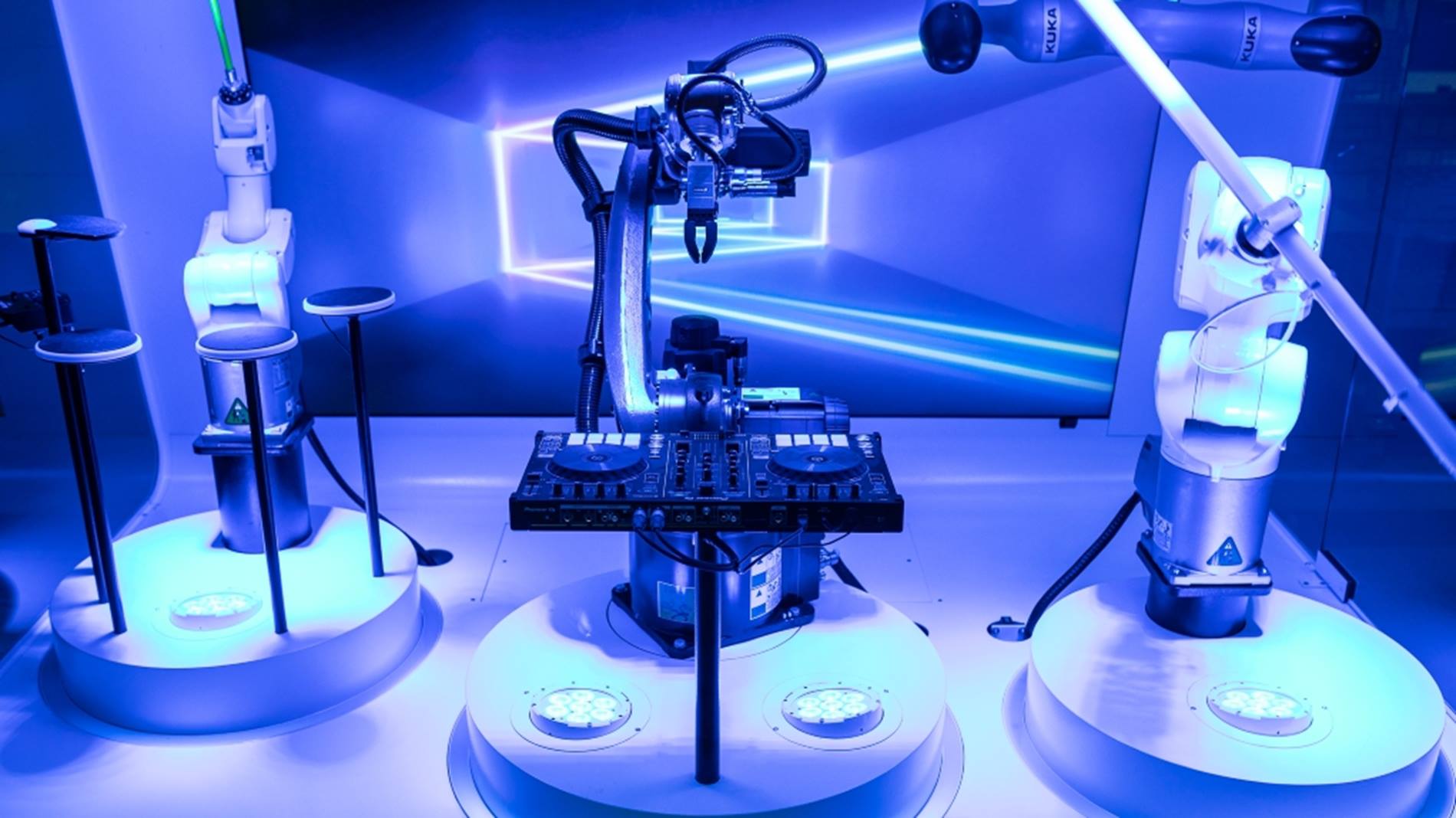
An AI robot DJ is back in the spotlight in Prague. The legendary Karlovy Lázně nightclub recently upgraded its robot DJ with advanced AI algorithms. As a result, it has reignited the debate about artificial intelligence in electronic music.
The KUKA robotic arm first appeared at the venue in late 2017. Now machine learning lets it read crowd energy, match BPM in real time and run smooth transitions all night. In other words, the five-story club has become ground zero for a divisive question: can a machine truly understand what makes people dance?
How the AI robot DJ works
The robot alternates hourly sets with human DJs. Its industrial pincer picks CDs from nearby racks and loads them into professional CDJs. It even scratches records while performing choreographed dance moves.
A Czech robotics firm first built the system as a novelty for the club. Since then, it has become far more advanced. Thanks to the new AI layer, the robot tracks tempo preferences and dance-floor energy. It also plans transitions that would challenge many human DJs.
Club manager Adam Lipsansky strongly backs the project. He told media that the robot is an attraction unseen elsewhere in Europe, and possibly the world. The venue calls itself Central Europe’s largest music club. It sees the robot both as a technical showcase and as a draw for curious clubbers. Typically, KUKA arms work in car factories. Here, the arm taps mixer knobs, adjusts EQs and picks tracks from a large digital library.
“It can’t feel what people want”
However, technical skill has not won everyone over. Clubgoers remain sharply divided. Critics say the robot lacks what separates great DJs from playlists: the ability to read emotion and respond by instinct. Club patron Marcia Lopes summed it up for Reuters. She said the machine “can’t feel what the people want to dance to.”
This criticism hits the core of electronic music’s identity crisis in 2026. AI is advancing fast across creative industries. Consequently, the dance community faces hard questions about authenticity, artistry and automation. The robot can execute every mechanical part of DJing perfectly. Yet it struggles with spontaneity, risk-taking and real connection with the crowd.
Part of a wider AI trend
The upgrade fits a broader pattern. Through 2025 and into 2026, machine learning reached almost every part of electronic music. Some festivals feature AI-generated performers. Streaming platforms curate playlists with algorithms. Meanwhile, production software now offers AI mastering, harmonic balancing and adaptive mixing.
Still, the Prague robot shows the limits of this optimism. In the studio, AI is a tool under human direction. On the dance floor, by contrast, the robot works almost on its own, exactly where human connection matters most. It can match keys and plan BPM changes. However, it cannot sense when a crowd needs a breather or when a familiar melody should drop.
A hybrid model, for now
The club’s choice to alternate human and robot DJs reflects this reality. The robot does not replace human talent. Instead, it shares the decks as a curiosity. It attracts attention and social media buzz. Meanwhile, the human DJs deliver the emotion and spontaneity that keep people coming back.
Some observers see robot DJs as the future of low-cost entertainment. After all, machines need no fees, breaks or ego management. For budget-conscious venues, that logic is tempting. Yet critics warn that this approach could turn nightlife into a sterile, metric-driven experience.
For now, the dance floors of Prague hold a nightly vote on the experiment. Some clubbers love the spectacle. Others drift toward the human DJs. In the end, the AI robot DJ at Karlovy Lázně is both a technical achievement and a cautionary tale. Whether future AI can close the gap remains one of electronic music’s most pressing questions.