

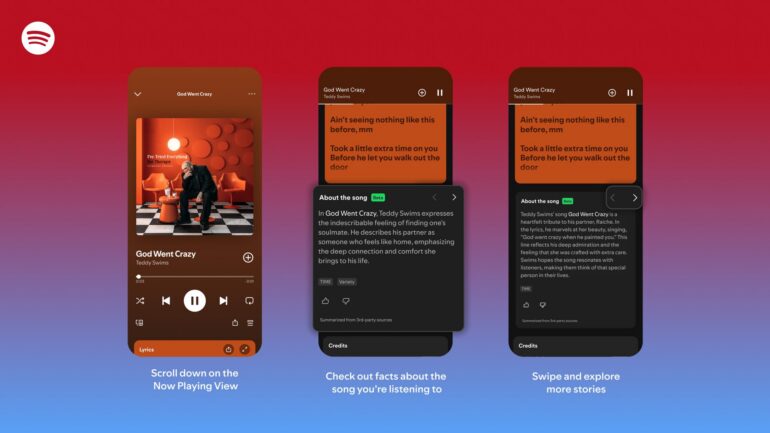
Spotify has officially rolled out “About the Song,” a groundbreaking feature that transforms passive listening into an immersive storytelling experience by revealing the hidden narratives and creative processes behind the music fans love. Announced February 5th, the beta feature integrates swipeable story cards directly into the Now Playing view, offering listeners instant access to song meanings, production details, cultural impact, and behind-the-scenes moments without ever leaving the app. The launch represents Spotify’s latest effort to deepen user engagement and differentiate itself from competitors like Apple Music by positioning context and discovery at the heart of the streaming experience rather than treating music as mere background audio.
The feature addresses a universal experience among music enthusiasts: that moment when a song stops you in your tracks and triggers an immediate desire to know more. What inspired the artist to write it? What’s the story behind the lyrics? Who contributed to its creation? Traditionally, satisfying this curiosity required leaving the streaming platform, searching through multiple websites, reading artist interviews, or consulting music databases. Spotify’s About the Song eliminates this friction by delivering curated information precisely when listeners are most emotionally engaged with a track, creating a seamless integration between consumption and discovery that keeps users immersed in the platform ecosystem.
Currently available in beta for Spotify Premium subscribers across the United States, United Kingdom, Canada, Ireland, New Zealand, and Australia, About the Song appears as a dedicated card when users scroll down in the Now Playing screen on mobile devices running iOS or Android. The interface presents short, swipeable story panels that users can navigate horizontally, with each card offering bite-sized insights synthesized from third-party sources including music publications, artist interviews, and cultural commentary. Spotify emphasizes transparency by citing sources on each card, addressing potential concerns about accuracy and attribution that have plagued similar AI-assisted features on other platforms. Users can provide feedback through integrated thumbs-up and thumbs-down buttons, helping Spotify refine the feature’s relevance and accuracy as it expands beyond beta testing.
The storytelling cards cover diverse aspects of musical creation and context. Some cards explore lyrical inspiration, revealing personal experiences or cultural moments that shaped a song’s narrative. Others highlight production techniques, detailing the creative choices engineers and producers made during recording sessions. Cultural impact cards contextualize how tracks influenced broader movements or gained unexpected significance through placements in films, television shows, or viral moments. For example, cards accompanying Metallica’s “Master of Puppets” reference the song’s renewed popularity following its prominent use in the 2022 season of “Stranger Things,” while Chappell Roan’s “Pink Pony Club” trivia reveals the Missouri strip club that inspired the track’s vibrant imagery.
About the Song builds upon Spotify’s recent initiatives to transform its platform from a simple music player into a comprehensive discovery and education tool. In November 2025, the company expanded its Song Credits feature to highlight previously overlooked contributors including engineers, mixers, background vocalists, and session musicians, moving beyond the standard performer and producer credits that dominated earlier versions. The company simultaneously previewed SongDNA, an interactive feature that maps musical connections by showing sampling relationships, cover versions, and collaborative networks between artists. These tools collectively signal Spotify’s strategic pivot toward emphasizing the human creativity and cultural context that algorithms alone cannot capture or replicate.
The timing of About the Song’s launch coincides with Spotify’s acquisition of WhoSampled, the community-built database documenting sampling, interpolation, and cover relationships across music history. This acquisition provides Spotify with an extensive repository of musical lineage data that enhances both SongDNA and About the Song, enabling the platform to surface connections that illuminate how artists build upon, reference, and reimagine existing work. For hip-hop heads curious about the breakbeat origins of their favorite tracks or electronic music fans wanting to trace the evolution of specific sounds across decades, these connected features promise unprecedented depth of insight delivered directly within the listening interface.
Industry observers note that About the Song represents Spotify’s attempt to recapture functionality previously offered through its now-defunct partnership with Genius, which provided “Behind the Lyrics” annotations from 2016 through 2019. That collaboration surfaced curated facts and artist commentary within the player, but ended amid controversies including criticism from artists like Hayley Williams of Paramore over inaccurate information appearing alongside her songs. Spotify subsequently tested “Storyline,” a limited feature allowing artists to submit their own contextual stories, but never fully launched it as a core offering. About the Song differs by synthesizing information from multiple third-party sources rather than relying on single partnerships or voluntary artist participation, theoretically providing broader coverage while maintaining editorial independence through citation transparency.
The feature’s reliance on machine learning to process and summarize information from publications like Variety, TIME, and specialized music journalism outlets positions it within the broader trend of AI-assisted content curation that streaming platforms increasingly employ. Spotify’s approach emphasizes that human-created source material forms the foundation, with artificial intelligence serving as an aggregation and presentation layer rather than generating novel claims or interpretations. This distinction matters in an environment where AI hallucination and misinformation represent significant concerns for both platforms and users. By linking to source material and soliciting feedback through rating mechanisms, Spotify attempts to balance the scalability benefits of machine learning with accountability structures that allow human oversight and correction.
The beta launch’s limitation to Premium subscribers reflects Spotify’s ongoing strategy to differentiate paid tiers through exclusive features that enhance rather than restrict core functionality. Free users retain access to music playback and basic lyrics, but miss contextual layers like About the Song that transform passive consumption into active discovery. This approach contrasts with competitors including YouTube Music, which recently began restricting lyrics access to Premium subscribers, a more aggressive paywall tactic that limits basic functionality rather than offering enhanced experiences. Spotify’s model positions Premium as delivering meaningfully richer engagement without eliminating fundamental features that free users expect from modern streaming services.
Early user feedback across social media and tech forums suggests About the Song resonates particularly strongly with listeners who enjoy learning trivia and deepening their understanding of favorite tracks. Multiple users describe experiencing “VH1 Pop-Up Video nostalgia,” referencing the influential 1990s MTV series that overlaid music videos with animated trivia bubbles. That comparison highlights how About the Song taps into established appetite for contextualized music consumption that predates streaming but has rarely been effectively integrated into digital platforms. The swipeable card interface feels native to contemporary mobile interaction patterns, making discovery feel like natural exploration rather than academic research or interruption of the listening flow.
However, some limitations have emerged during beta testing. Coverage remains inconsistent, with major label artists and commercially successful tracks more likely to feature extensive story cards while independent and niche music often lacks contextual information. This disparity reflects the availability of source material, as mainstream artists generate more journalistic coverage, interviews, and cultural commentary that machine learning systems can synthesize. Spotify has acknowledged that not every track carries complex backstories, noting that for simpler narratives the system defaults to album-level trivia or AI-generated lyrical summaries describing potential meanings. This fallback approach risks diluting the feature’s value proposition when users encounter generic summaries rather than genuinely revealing insights.
The feature also faces questions about depth and comprehensiveness. Individual story cards prioritize brevity, typically presenting one or two sentences alongside citations rather than detailed exposition. This design choice optimizes for mobile reading and quick consumption but may frustrate listeners seeking comprehensive understanding of particularly complex creative processes or cultural contexts. The swipeable format encourages exploration but doesn’t facilitate the kind of deep reading that dedicated music journalism or artist interviews provide. Spotify appears to position About the Song as a gateway to curiosity rather than definitive reference material, using citations to direct interested users toward fuller treatments while keeping most listeners engaged within the streaming platform.
From an artist and industry perspective, About the Song creates both opportunities and concerns. For musicians whose work carries interesting creative stories, the feature provides unprecedented visibility for contextual narratives that traditionally required active fan research to discover. A casual listener encountering revelations about song inspiration, recording challenges, or unexpected influences may develop deeper emotional connection to music they previously enjoyed superficially. This deeper engagement potentially translates to increased streaming, playlist additions, and artist loyalty as fans move from passive consumers to invested enthusiasts who understand and appreciate creative processes.
However, the automated nature of content synthesis raises control questions for artists who may prefer to curate their own narratives or correct inaccuracies that emerge from third-party sources. Unlike Storyline, which allowed direct artist input, About the Song operates independently of artist participation, potentially surfacing interpretations or factoids that musicians find reductive or misleading. The feedback mechanism theoretically allows correction over time, but places the burden on discovering and reporting inaccuracies rather than preventing them through artist review processes. This tension between scalability and accuracy will likely influence how artists and management teams respond to the feature’s eventual wider rollout.
The competitive landscape surrounding contextual music features remains relatively underdeveloped despite obvious user interest. TIDAL has offered interactive credits that allow exploration through contributor networks for several years, but hasn’t emphasized storytelling and trivia to the same degree. Apple Music, Spotify’s primary competitor, lacks equivalent functionality despite generally offering superior audio quality and tight ecosystem integration for iOS device users. Amazon Music and YouTube Music similarly focus on playback and recommendation rather than contextual enrichment. About the Song potentially provides Spotify meaningful differentiation that reinforces its positioning as the platform for discovery-oriented listeners rather than pure consumption.
Looking forward, Spotify’s broader feature rollout cadence suggests About the Song will expand beyond English-language support and initial six-country availability if beta testing proves successful. The company has demonstrated willingness to iterate features extensively before full launches, as evidenced by multi-year development cycles for SongDNA and persistent experimentation with social features, AI playlist generation, and audiobook integration. About the Song fits naturally within Spotify’s vision of becoming a comprehensive audio platform rather than merely a music streaming service, with contextual storytelling applicable to podcasts, audiobooks, and other spoken content that benefits from background information and creator insights.
The feature also opens possibilities for enhanced monetization and partnership arrangements. Music publications, cultural critics, and specialized media outlets whose content gets synthesized into story cards could potentially negotiate licensing agreements or affiliate relationships with Spotify, creating revenue streams for journalism that increasingly struggles with direct monetization. Artists might eventually gain options to sponsor or promote specific story cards, ensuring certain narratives or contexts receive prominence alongside their music. These commercial possibilities require careful balancing against maintaining editorial independence and user trust, but represent logical extensions of About the Song’s infrastructure once core functionality stabilizes.
For music fans, About the Song delivers tangible value by answering questions that naturally arise during listening without requiring disruption or research effort. The feature acknowledges that great music inspires curiosity about creative processes, cultural contexts, and human stories behind tracks that move us. By integrating that information directly into the listening experience, Spotify transforms streaming from passive background activity into active engagement that deepens appreciation and understanding. Whether this enhanced experience translates to increased Premium subscriptions, longer listening sessions, or stronger platform loyalty remains to be seen as beta testing expands and user behaviors crystallize.


