


A KUKA robotic arm has taken up permanent residency at Karlovy Lázně, marking a controversial milestone in electronic music’s ongoing relationship with artificial intelligence
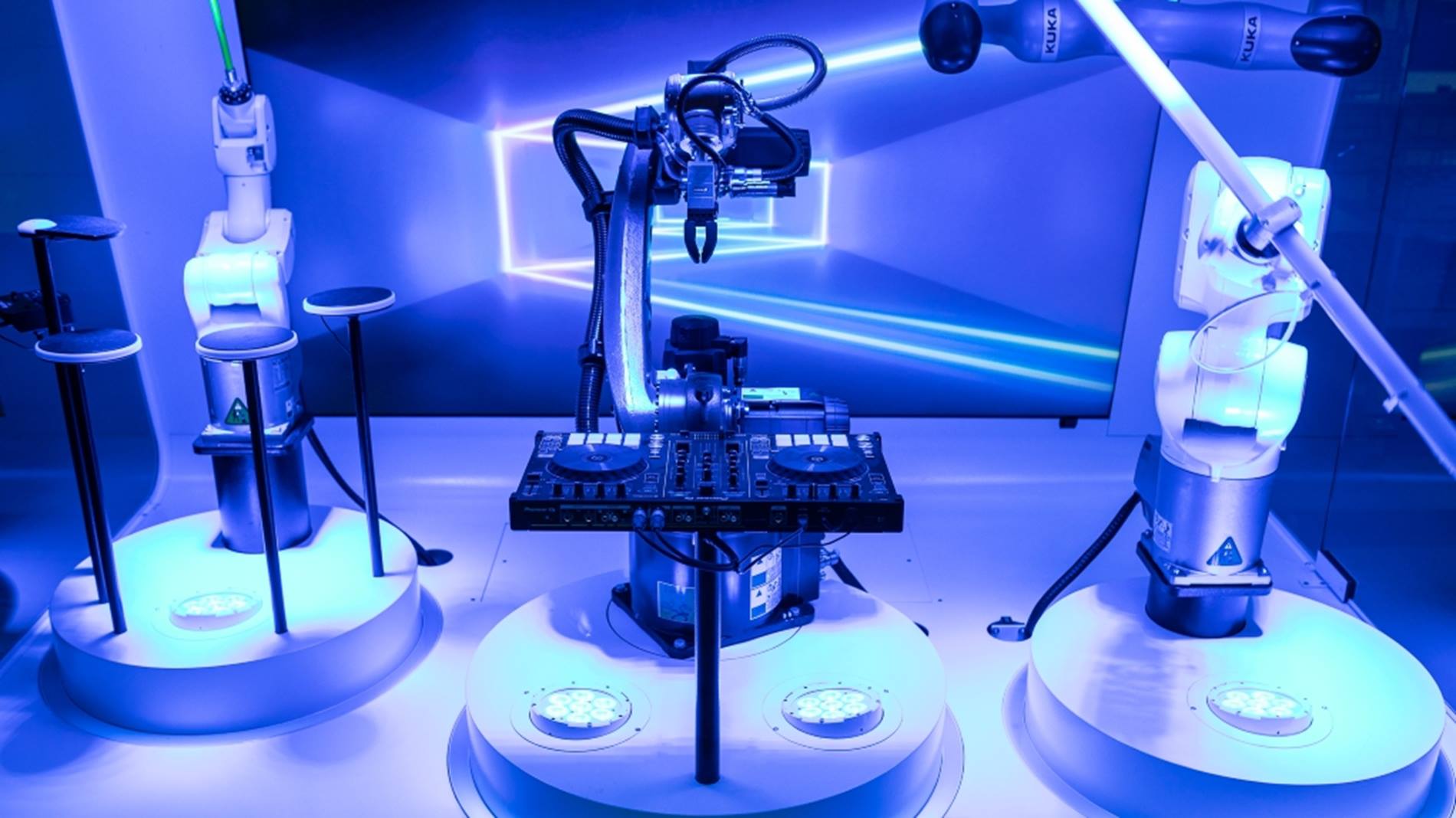
Prague’s legendary Karlovy Lázně nightclub has reignited the debate about artificial intelligence in electronic music after recently upgrading its robot DJ with advanced AI algorithms. The KUKA robotic arm, which first debuted at the venue in late 2017, has been enhanced with machine learning capabilities that allow it to analyze crowd energy, match BPM in real-time, and execute flawless transitions throughout the night. The move positions the five-story club as ground zero for one of dance music’s most divisive experiments: can a machine truly understand what makes people dance?
The robot DJ alternates hourly sets with human counterparts, using its industrial-grade pincer to select CDs from nearby racks, load them into professional CDJs, and even scratch records while performing choreographed dance moves. Originally developed as a novelty attraction by a Czech robotics firm commissioned by club management, the system has evolved into something far more sophisticated. The recent AI integration enables the robot to process real-time data including tempo preferences, energy levels on the dance floor, and seamless song transitions that would challenge even experienced human DJs.
Club manager Adam Lipsansky has doubled down on the technology’s potential, telling media outlets that the robot represents a unique attraction unseen elsewhere in Europe or possibly the world. The venue, which bills itself as Central Europe’s largest music club, has invested heavily in the robotic experiment as both a technical showcase and a draw for curious clubbers. The KUKA arm, typically employed in automotive manufacturing, executes its DJ duties with mechanical precision, tapping mixer knobs, adjusting equalizers, and selecting tracks from an extensive digital library programmed into its software.
But the robot’s technical capabilities haven’t translated into universal acceptance. Since its introduction, clubgoers have remained sharply divided on the machine’s merit as a legitimate DJ. Critics argue that the system lacks the fundamental quality that separates great DJs from playlist algorithms: the ability to read human emotion and respond with intuition. Marcia Lopes, a club patron who witnessed the robot’s performance, captured the skepticism succinctly when she told Reuters that the machine “can’t feel what the people want to dance to” and lacks the emotional intelligence that defines authentic DJ culture.
This criticism strikes at the heart of electronic music’s identity crisis in 2026. As artificial intelligence rapidly advances across creative industries, the dance music community finds itself wrestling with uncomfortable questions about authenticity, artistry, and automation. The Prague experiment reveals a fundamental tension: while AI can technically execute every mechanical function of DJing with flawless precision, it struggles to replicate the spontaneous creative choices, risk-taking, and crowd connection that transform a competent set into a transcendent experience.
The timing of Karlovy Lázně’s AI upgrade coincides with broader industry trends. Throughout 2025 and into 2026, machine learning has penetrated nearly every aspect of electronic music production. Major festivals have begun featuring AI-generated performers, streaming platforms use sophisticated algorithms to curate personalized playlists, and production software now incorporates intelligent plugins that handle mastering, harmonic balancing, and adaptive mixing. According to recent industry analyses, many professionals believe EDM and electronic genres are particularly adaptable to AI-assisted creativity due to their emphasis on technical precision and repetitive structures.
Yet the Prague robot exposes the limitations of this optimism. Unlike studio production where AI serves as a collaborative tool under human direction, the robot DJ operates semi-autonomously on the dance floor where human connection matters most. The machine can analyze statistical patterns, match keys, and calculate optimal BPM progressions, but it cannot sense the subtle shift in crowd energy when a familiar melody drops, recognize when dancers need a moment to breathe, or take the inspired risk that defines memorable nights.
Industry observers note that the robot’s reception mirrors broader concerns about automation in creative fields. While AI tools have proven invaluable for accelerating workflows and democratizing music production, they struggle with the improvisational, emotionally intelligent aspects of live performance. The Prague experiment suggests that certain creative roles may prove naturally resistant to full automation not because machines lack technical skill, but because audiences value the specifically human elements of creativity, unpredictability, and shared experience.
The club’s strategy of alternating human and robot DJs acknowledges this reality. Rather than replacing human talent entirely, Karlovy Lázně has positioned the robot as a curiosity that shares deck duties rather than monopolizing them. This hybrid approach allows the venue to capitalize on the novelty factor while maintaining the human connection that keeps clubbers returning. The robot attracts attention, generates social media buzz, and offers a glimpse of potential futures, but the human DJs provide the emotional resonance and creative spontaneity that ultimately define quality nightlife experiences.
From a technical standpoint, the upgraded system represents impressive engineering. The KUKA arm’s ability to physically manipulate CDs, operate professional DJ equipment, and coordinate movements with musical timing demonstrates sophisticated robotics. The AI layer adds adaptive decision-making that goes beyond simple playlist shuffling, incorporating real-time analysis that mimics aspects of human DJ thought processes. The robot can theoretically account for genre preferences, energy curves, and transition smoothness in ways that basic automated systems cannot.
However, critics including prominent DJs and music journalists argue that technical competence misses the point. DJ culture has always been about more than beat-matching and track selection. It encompasses reading rooms, building narrative arcs across hours-long sets, taking creative risks, and establishing emotional rapport with dancers. These skills require empathy, intuition, and the kind of embodied intelligence that emerges from being physically present in spaces with other humans. A robot may execute flawless technical DJing, but it cannot participate in the social ritual that makes clubbing meaningful.
The debate extends beyond Karlovy Lázně to fundamental questions about AI’s role in creative industries. As machine learning systems become more sophisticated, they inevitably encroach on domains previously considered uniquely human. Music, art, writing, and performance face similar pressures from advancing automation. The Prague robot serves as a visible symbol of these tensions, forcing both industry professionals and audiences to articulate what they value about human creativity and where they’re willing to accept machine substitutes.
Some observers view the robot DJ as the inevitable future of cost-optimized entertainment. Machines don’t require payment, breaks, or accommodation of creative egos. They perform tirelessly, consistently, and without the unpredictability that characterizes human talent. For budget-conscious venues, the economic logic is compelling. But this efficiency-first approach risks transforming nightlife from a space of authentic connection into a sterile, algorithmic experience optimized for metrics rather than meaning.
The Prague experiment also highlights how AI development in creative fields often prioritizes technical capability over artistic value. Engineers can build systems that execute the mechanical functions of DJing, but replicating the artistic judgment, emotional intelligence, and spontaneous creativity of talented humans remains elusive. The gap between technical competence and artistic excellence may prove more significant than AI optimists anticipated, especially in domains where human connection and emotional resonance define quality.
As 2026 progresses, the robot DJ at Karlovy Lázně stands as both a technical achievement and a cautionary tale. It demonstrates how far robotics and AI have advanced while simultaneously revealing their limitations. The machine succeeds as a novelty attraction and conversation starter but struggles to deliver the emotional experiences that define great DJing. Whether this represents a temporary limitation that future AI will overcome or a fundamental boundary between human and machine creativity remains one of electronic music’s most pressing questions.
For now, the dance floors of Prague offer a nightly referendum on the experiment. Some clubbers embrace the spectacle and marvel at the technology. Others drift toward the human DJs, seeking the connection and spontaneity that only human artists can provide. The robot continues its hourly rotation, executing technically perfect sets for crowds that remain divided on whether perfect technique equals authentic artistry. In this standoff between human and machine, the future of electronic music culture hangs in the balance.