

Live 12.3’s most talked-about addition is native stem separation. Instead of sending tracks to external services or standalone apps, producers can now right-click any audio clip in Session or Arrangement View and split it into separate stems for vocals, drums, bass and other elements. The feature is powered by technology from Music.AI, the team behind Moises, and runs locally on the user’s machine, so audio never has to leave the project. Once processing is complete, Live lays out the new stems on fresh tracks and mutes the original clip, making it easy to reference the source while rebuilding the arrangement from isolated parts.
Listeners:
Top listeners:
00:00
00:00
volume_up
chevron_left
-
 play_arrow
Revolution 93.5 – MIAMI WZFL - SOUTH FLORIDA
REVOLUTION 935 - THE DANCE STATION
Ableton has rolled out the public beta of Live 12.3, and the update is already making noise across the producer community thanks to built-in stem separation and deep Splice integration directly inside the DAW.
The beta includes both a fast mode, ideal for quick sketching and rough ideas, and a higher-quality mode designed for cleaner extractions when working on official remixes or label projects. For DJs and remix-focused producers, this removes a major bottleneck. A full track can now be dropped into Live, split into stems, and immediately repurposed: vocals can be chopped and processed, drums can be swapped for fresh kits, basslines can be resampled or converted to MIDI, and “other” elements can be stretched, filtered and automated without leaving the main session.
Stem separation also extends to Push 3 Standalone, where users can load tracks and perform live edits or mashups without a laptop. Being able to carve out vocals or drums directly on hardware reinforces Ableton’s long-standing vision of Live as both a studio and stage instrument. For touring acts who rely on edits and bootlegs in their sets, this kind of onboard stem control can drastically compress prep time and make last-minute changes more realistic.
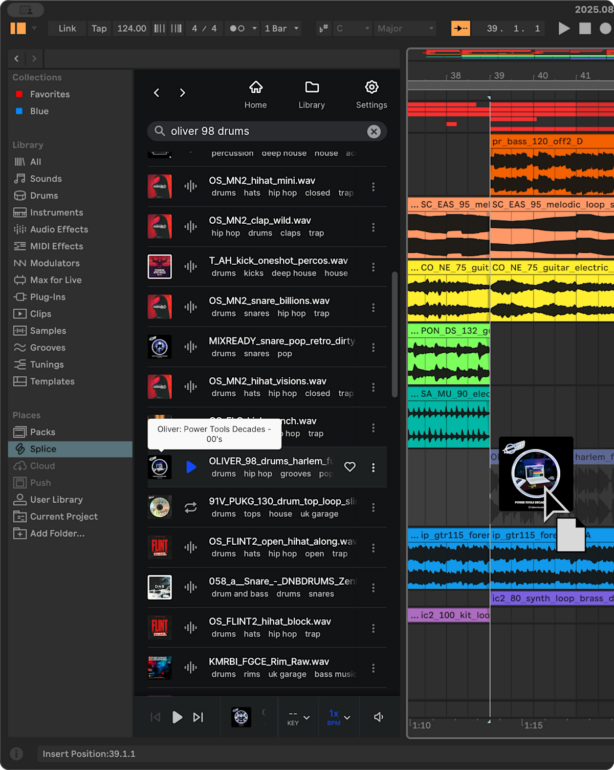
Running alongside stems, the other major headline is Splice integration. Instead of switching between Ableton and a browser or desktop app, Splice’s library now appears as a panel in Live’s Browser. Producers can search, filter and audition royalty-free loops and one-shots in sync with their project tempo and conformed to project key, then drag them straight into the arrangement. The experience feels much closer to browsing built-in content than juggling a separate platform in the background.
A new feature called Search with Sound digs deeper into this workflow. By dragging a clip or a selected portion of a track into the Splice panel, users can ask the system to analyze the rhythm and harmony of what is already in the session and return samples that naturally fit. Instead of guessing which drum loop or melodic phrase will work, producers can audition curated options that match the existing groove and chord movement, dramatically reducing the time spent cycling through unrelated material.
Practical use cases appear quickly: a producer might import a reference track, separate stems, keep the drums as a structural anchor, and then turn to the integrated Splice panel to find percussion, tops and melodic loops that blend musically with that foundation. Because everything stays inside Live, each creative decision—warping, processing, layering, automating—remains non-destructive and easy to adjust later. This tight integration blurs the lines between DJ edit, bootleg remix and original composition in a way that reflects how many EDM tracks are actually built today.
Live 12.3 does not stop at stems and Splice. The beta also introduces smarter bounce options, including the ability to bounce group tracks in place or to new tracks, making it easier to commit complex buses for CPU savings or to generate clean stems for mixdown and live shows. Paste Bounced Audio speeds up the process of replacing heavy chains with printed audio. Device updates bring new life to familiar tools, with Auto Pan now covering tremolo-style modulation more clearly and expressive chord and pattern tools offering extra melodic starting points.
On Push 3, the update adds more expressive control and tighter integration with the new features, reinforcing the idea that Live’s hardware ecosystem is evolving in step with the software. For users invested in Push as a central instrument, the combination of onboard stem separation, improved modulation and smarter bouncing makes the hardware feel more self-sufficient and performance-ready than in previous generations.
For existing Live 12 owners, 12.3 will land as a free update once the beta period concludes, meaning that advanced stem tools and Splice workflows become standard rather than optional add-ons. Producers who live in the world of samples, reference tracks and edits will likely feel the impact most, but even MIDI-heavy creators stand to benefit from the refined bouncing, device tweaks and hardware improvements. In a DAW market where AI-assisted tools and tighter content integrations are becoming the norm, Live 12.3 shows Ableton’s intent to keep its flagship firmly in the center of modern production habits—reducing friction between ideas, sound sources and finished tracks.